
Hoi-Poi Capsules: Difference between revisions
Jpranevich (talk | contribs) →Capsule Corporation capsules: add 339 |
Jpranevich (talk | contribs) |
||
| Line 60: | Line 60: | ||
File:Item-capsule-240-airplane-manga.png|Capsule #240 (Airplane) from [[Dragon Ball Chapter 155]] | File:Item-capsule-240-airplane-manga.png|Capsule #240 (Airplane) from [[Dragon Ball Chapter 155]] | ||
File:Item-capsule-339-airplane-manga.png|Capsule #339 (Cargo Airplane) from [[Dragon Ball Chapter 329]] | File:Item-capsule-339-airplane-manga.png|Capsule #339 (Cargo Airplane) from [[Dragon Ball Chapter 329]] | ||
File:Item-capsule-576-cargo-plane-manga.png|Capsule #576 Cargo Airplane) from [[Dragon Ball Chapter 356]] | |||
</gallery> | </gallery> | ||
===Capsule Corporation capsules (Trunks's future)=== | |||
The following items are numbered [[Capsule Corporation]] capsules from Trunks's alternate future timeline. | |||
<gallery caption="Numbered Capsule Gallery (Trunks's Future)" widths="120px" heights="120px" > | |||
File:Item-capsule-2031-fridge-manga.png|Capsule #2031 (Refrigerator) from [[Dragon Ball Chapter 333]] | |||
</gallery> | |||
(time machine 335) | |||
===Red Ribbon Army capsules=== | ===Red Ribbon Army capsules=== | ||
| Line 89: | Line 99: | ||
File:Item-capsule-unknown-pilaf-mecha.png|A three-part mecha for the Pilaf Gang from [[Dragon Ball Chapter 109|Chapter 109]]. Each part originated in its own capsule. | File:Item-capsule-unknown-pilaf-mecha.png|A three-part mecha for the Pilaf Gang from [[Dragon Ball Chapter 109|Chapter 109]]. Each part originated in its own capsule. | ||
File:Item-capsule-unknown-shark-plane.png|A shark-shaped airplane used by the Tournament Announcer in [[Dragon Ball Chapter 134|Chapter 134]] | File:Item-capsule-unknown-shark-plane.png|A shark-shaped airplane used by the Tournament Announcer in [[Dragon Ball Chapter 134|Chapter 134]] | ||
File:Item-capsule-yajirobe-aircar.png|An aircar used by Yajirobe in [[Dragon Ball Chapter 144|Chapter 144]]. | File:Item-capsule-yajirobe-aircar.png|An aircar used by Yajirobe in [[Dragon Ball Chapter 144|Chapter 144]]. It was seen again (and destroyed) in [[Dragon Ball Chapter 337|Chapter 337]]. | ||
File:Item-capsule-unknown-rice-cooker.png|An electric rice cooker owned by the Turtle Hermit in [[Dragon Ball Chapter 144|Chapter 146]] | File:Item-capsule-unknown-rice-cooker.png|An electric rice cooker owned by the Turtle Hermit in [[Dragon Ball Chapter 144|Chapter 146]] | ||
File:Item-capsule-unknown-airplane-ch155.png|An airplane piloted by Oolong in [[Dragon Ball Chapter 155|Chapter 155]]. It may be another copy of #239 or #240. | File:Item-capsule-unknown-airplane-ch155.png|An airplane piloted by Oolong in [[Dragon Ball Chapter 155|Chapter 155]]. It may be another copy of #239 or #240. | ||
Revision as of 17:06, 6 January 2019
| Hoi-Poi Capsule | |
|---|---|
| ホイポイカプセル (Hoi-Poi Kapuseru) | |
|
Manga  Anime  | |
| English Name(s) |
Hoi-Poi Capsule (Viz) Dyno-caps (Funimation) |
| Manga Debut | Dragon Ball Chapter 1 |
| Anime Debut | Dragon Ball Episode 1 |
| Appears in | Manga & Anime |
Hoi-Poi Capsules, generally referred to simply as capsules, are devices which allow for the shrinking of inorganic objects down to portable size. Capsules are some of the first technologies introduced in the Dragon Ball series by Akira Toriyama, appearing in its first chapter. An earlier incarnation of capsules were included in one of Toriyama's Dragon Ball-prototype-esque one-shots, The Adventure of Tongpoo.
General Overview

Hoi-Poi Capsules are a key element to the background technology of the series. Each Hoi-Poi Capsule is a numbered cylinder with a button on top. Activating the capsule is achieved by clicking the button and tossing it; the contained object will appear with a "Bom!" sound effect.[1] The expanded capsule can be shrunk again by pushing a button on the expanded object.[2] For safe-keeping, capsules are often kept in a hard case when not in use.[3] The exact process for encapsulation is unknown, though Bulma describes it as shrinking the objects into its component particles.[4] The resulting capsules are light-weight and portable, regardless of how large of an object was placed inside. Although most capsules in the series are only shown to contain the vehicle, house, or weapon that they were designed for, Bulma designed freezer capsules that permitted the cold storage of dead bodies, such as Kuririn's after he is killed by Tambourine.[5]
The capsules produced by Capsule Corporation appear to be individually numbered, excepting Trunks' time machine which returned to number one.[6] In all, the following numbered capsules have been seen in the manga:[7]

- Capsules 1-4: Houses
- Capsule 8: Motorboat
- Capsules 9, 12, 14, 67: Motorbikes
- Capsules 61, 103, 115, 192, 239, 240, 339, 576, 991: Planes
According to Daizenshuu 7, Hoi-Poi Capsules were invented by Dr. Brief and led to a "Capsule Revolution" around the world, contributing to the easy distribution of luxury goods and allowing for rapid technological progress.[8] Capsule Corporation started with manufacturing capsules, but expanded into creating vehicles and electronics to go into those capsules. Their competitors included the Red Ribbon Army, which was primarily focused on capsules and vehicles for military use. By Age 750, Capsule Corporation controlled the near-majority of the worldwide vehicle market (48%). In addition to capsules, Capsule Corporation also sells popular clothing and electronics brands around the world.[9]
Name
Hoi-Poi Capsules are named for the sounds that are made when the capsules are deployed. In Dragon Ball Chapter 1, Bulma shouts "Hoi" (ほいっ) when she throws a capsule, with the sound effect "Poi" (ポイッ) appearing as the sound of capsule in the air. The word "Capsule" for カプセル (kapuseru) is frequently written out in Latin characters throughout the series.
Production

The concept of capsules was initially explored in Akira Toriyama's one-shot, The Adventure of Tongpoo, originally printed 29 November 1983 in Weekly Shōnen Jump as one of a series of experiments culminating in Dragon Ball. In this science-fiction series, Tongpoo, an analog for Son Goku, explores a strange planet. By boiling specially designed "variety capsules" (いろいろカプセル, iro-iro kapuseru), Tongpoo is able to extract a jet-bike and a house to aid in his explorations, just as Bulma would subsequently do in the Dragon Ball series when meeting Goku for the first time.[10] In Dragon Ball, Toriyama dropped the requirement that the capsules be boiled before use.
Capsules in the Manga
Capsule Corporation capsules
The following items are numbered Capsule Corporation capsules used throughout the series.
- Numbered Capsule Gallery
-
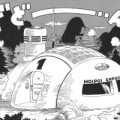 Capsule #1 (House) from Chapter 2
 -
 An advertisement for Capsule #2 (House) from Chapter 16
 -
 An advertisement for Capsule #3 (House) from Chapter 16
 -
 An advertisement for Capsule #4 (House) from Chapter 16
 -
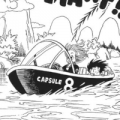 Capsule #8 (Boat) from Chapter 6
 -
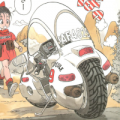 Capsule #9 (Motorcycle) from Chapter 1
 -
 An advertisement for Capsule #12 (Motorcycle) from Chapter 16
 -
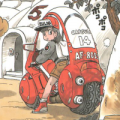 Capsule #14 (Motorcycle) from Chapter 4
 -
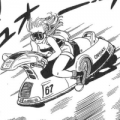 Capsule #67 (Aircycle) from Dragon Ball Chapter 69
 -
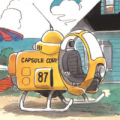 Capsule #87 (Helicopter) from Chapter 196
 -
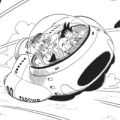 Capsule #82 (Aircar/Submarine) from Dragon Ball Chapter 71
 -
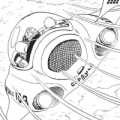 Capsule #103 (Aircar) from Chapter 204
 -
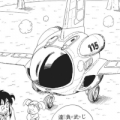 Capsule #115 (Airplane) from Chapter 23
 -
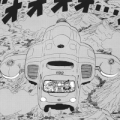 Capsule #192 (Cargo Airplane) from Chapter 241
 -
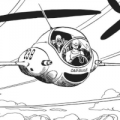 Capsule #239 (Airplane) from Dragon Ball Chapter 142
 -
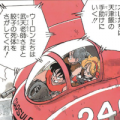 Capsule #240 (Airplane) from Dragon Ball Chapter 155
 -
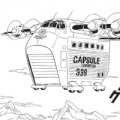 Capsule #339 (Cargo Airplane) from Dragon Ball Chapter 329
 -
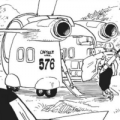 Capsule #576 Cargo Airplane) from Dragon Ball Chapter 356


Capsule Corporation capsules (Trunks's future)
The following items are numbered Capsule Corporation capsules from Trunks's alternate future timeline.
- Numbered Capsule Gallery (Trunks's Future)
-
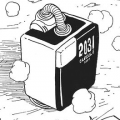 Capsule #2031 (Refrigerator) from Dragon Ball Chapter 333

(time machine 335)
Red Ribbon Army capsules
The Red Ribbon Army primarily produced capsules for military use.
- Red Ribbon Army Capsules
-
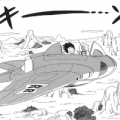 Red Ribbon Army Capsule #3 (Airplane) from Chapter 56
 -
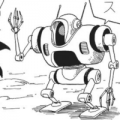 Red Ribbon Army robot from Chapter 56
 -
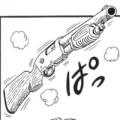 Red Ribbon Army capsule shotgun from Chapter 78
 -
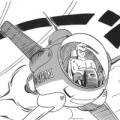 Red Ribbon Army capsule airplane from Chapter 80
 -
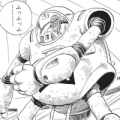 Red Ribbon Army capsule Battle Jacket from Chapter 95


Other capsules
These items are seen (or implied) to have come from a capsule, but do not show a number. They may have been developed by Capsule Corporation or a competitor. These include items in the series only, not cover pages or auxiliary artwork.
- Other Capsules
-
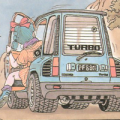 Bulma's "Turbo" car from Chapter 1
 -
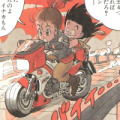 Bulma's Kawasaki KR250 motorcycle from Chapter 2
 -
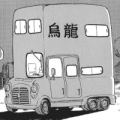 Oolong's motorhome from Chapter 9
 -
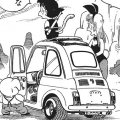 A replacement car provided by Yamcha in Chapter 10
 -
 Kame House, the Turtle Hermit's residence. First seen in Chapter 12; revealed to be a capsule house in Chapter 28.
 -
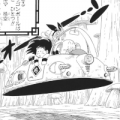 An aircar owned by the Ox Demon King in Chapter 15
 -
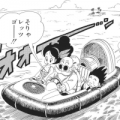 A hovercraft owned by the Turtle Hermit in Chapter 28
 -
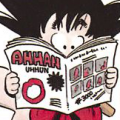 A special capsule invented by Dr. Brief to store pornography from Chapter 70
 -
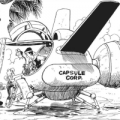 A rocket-plane from Capsule Corporation headquarters from Chapter 94
 -
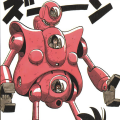 A three-part mecha for the Pilaf Gang from Chapter 109. Each part originated in its own capsule.
 -
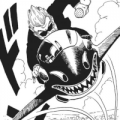 A shark-shaped airplane used by the Tournament Announcer in Chapter 134
 -
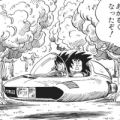 An aircar used by Yajirobe in Chapter 144. It was seen again (and destroyed) in Chapter 337.
 -
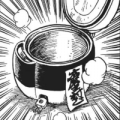 An electric rice cooker owned by the Turtle Hermit in Chapter 146
 -
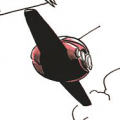 An airplane piloted by Oolong in Chapter 155. It may be another copy of #239 or #240.
 -
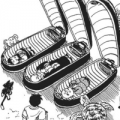 Freezer/coffin capsules created by Bulma. Depicted in Chapter 165.
 -
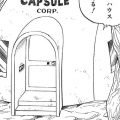 A capsule house (resembling #2 or #3) used by Bulma on Namek from Chapter 258.


Notes
TBD
External Links
TBD
References
- ↑ Toriyama, Akira. Dragon Ball Chapter 1: "Bulma and Son Goku". Weekly Shōnen Jump, 1984 #51. Japan: Shueisha, 20 November 1984.
- ↑ Toriyama, Akira. Dragon Ball Chapter 4: "Kame-Sen'nin's Kinto-Un". Weekly Shōnen Jump, 1985 #03. Japan: Shueisha, 11 December 1984.
- ↑ Toriyama, Akira. Dragon Ball Chapter 1: "Bulma and Son Goku". Weekly Shōnen Jump, 1984 #51. Japan: Shueisha, 20 November 1984.
- ↑ Toriyama, Akira. Dragon Ball Chapter 423: "The Birth of a New Hero!!". Weekly Shōnen Jump, 1993 #25. Japan: Shueisha, 25 May 1993.
- ↑ Toriyama, Akira. Dragon Ball Chapter 137: "Come Back, Son Goku!". Weekly Shōnen Jump, 1987 #37. Japan: Shueisha, 11 August 1987.
- ↑ Toriyama, Akira. Dragon Ball Chapter 332: "A Second Super Saiyan". Weekly Shōnen Jump, 1991 #31. Japan: Shueisha, 09 July 1991.
- ↑ "Item Dictionary". Dragon Ball Daizenshuu 7: Dragon Ball Large Encyclopedia. Japan: Shueisha, 05 February 1996. ISBN 4-08-782757-7. (pp. 178-181)
- ↑ "Culture - Earth". Dragon Ball Daizenshuu 7: Dragon Ball Large Encyclopedia. Japan: Shueisha, 05 February 1996. ISBN 4-08-782757-7. (p. 40)
- ↑ "Capsule Corporation Spreading Throughout the World". Dragon Ball Daizenshuu 7: Dragon Ball Large Encyclopedia. Japan: Shueisha, 05 February 1996. ISBN 4-08-782757-7. (pp. 202-203)
- ↑ Toriyama, Akira. The Adventure of Tongpoo. Weekly Shōnen Jump, 1983 #52. Japan: Shueisha, 29 November 1983. (pp. ##-##)