Thank you



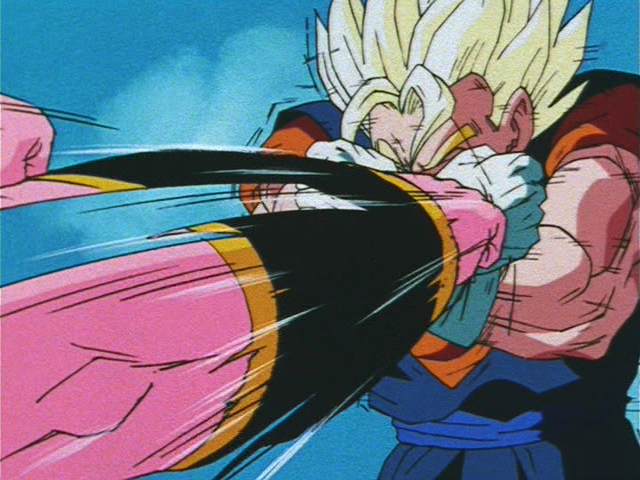


That was my fault. I use VLC filters to try and remove the reddish tint and lower the contrast and saturation a bit lol. I forgot I still had it on when I took the screen cap >< I'll try taking 100% authentic screencap when I get back from the storeDaimo-Rukiri wrote:Is it just me or are the colors warmer on the US Boxes? Personally prefer them.
But never knew they were that compressed compared to the JP Box! Of course I never bothered to do a side by side comparison, I did for one episode but other than brightness they looked the same.
Of course I was viewing it on my Macbook pro not my calibrated monitor that I use for work.
I agree with Hujio.kei17 wrote:For your information, you can't get faithful screencaps by resizing them to 4:3. The pixel aspect ratio of "4:3" DVD footage is 10:11, which means that the display aspect ratio is 15:11 instead of 4:3. That is to say, you should resize 720x480 to 720x528 or crop eight pixels on the both right and left sides (704x480) and then resize it to 4:3. On VLC media player, you can add custom aspect ratios, so add 15:11 and 20:11 (widescreen DVD) for convenience.
From what I know, TVs do show "4:3" DVDs in 15:11. On a 4:3 TV, the screen itself is exact 4:3 of course, but when you watch "4:3" DVDs on it, the image you see is always vertically a little squashed (PAR 10:11, DAR 15:11) than what you get by directly resizing 720x480 to 640x480. That's how digital SD footage works on real TVs, so 15:11 is still correct even if you take "actual viewing" in consideration.MarcFBR wrote:I agree with Hujio.
The point is to more emulate how they will appear during actual viewing (without ignoring how things are stored on the disk.)
This kind of misses the point entirely. At some point it ends up "You have what you have." I'm not going to play 'figure out if the aspect ratio is correct' for every DVD.kei17 wrote:From what I know, TVs do show "4:3" DVDs in 15:11. On a 4:3 TV, the screen itself is exact 4:3 of course, but when you watch "4:3" DVDs on it, the image you see is always vertically a little squashed (PAR 10:11, DAR 15:11) than what you get by directly resizing 720x480 to 640x480. That's how digital SD footage works on real TVs, so 15:11 is still correct even if you take "actual viewing" in consideration.MarcFBR wrote:I agree with Hujio.
The point is to more emulate how they will appear during actual viewing (without ignoring how things are stored on the disk.)
Some recent DVD-compatible Blu-ray players and most media player softwares for PC ignore this rule because the difference is so small that normal people never care, so maybe 4:3 would be faithful to your personal "actual viewing" on such players, but it's still wrong and different from how it's intended to be and actually seen on TVs.
However, I don't say that you should apply 15:11 or 20:11 to every kind of DVD. There are widescreen DVDs that are authored in exact 16:9, which tend to be downscaled from HD footage. The Orange Bricks are one such example. I don't know whether this kind of DVDs are just done wrong or intentionally done that way for the said recent Blu-ray players and PCs. But anyway, the Dragon Boxes were produced in the SD era and obviously intended to be seen in 15:11 on TVs.
You can read a discussion on this matter on the official forum of VLC media player. https://forum.videolan.org/viewtopic.php?f=2&t=102078
Technical details on Pegasys's website (Japanese): http://tmpgenc.pegasys-inc.com/ja/suppo ... Ratio.html