
- November 14, 2003 (Europe)
November 23, 2003 (Australia)
December 4, 2003 (North America)
February 5, 2004 (Japan)
Genre(s): Fighting
Developer(s): Dimps
Publisher(s):
- Bandai (Japan/Europe)
Atari (North America/Australia)
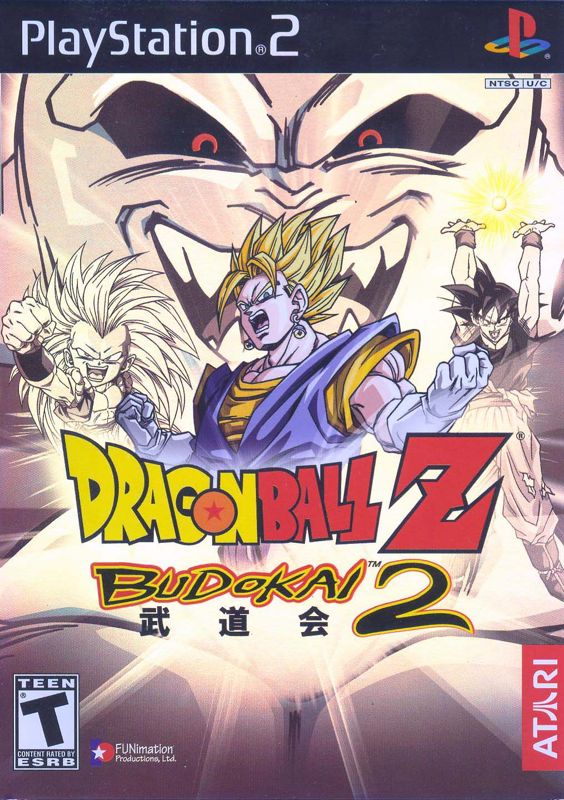
Overview
Just about a year earlier, Dragon Ball Z: Budokai was released and even though it received conflicting reviews from critics it was a huge commercial success and it was well-liked by fans so there was no doubt in mind a sequel would be in the makings. Dragon Ball Z had officially aired it's final episode in the US and that's where Dragon Ball Z: Budokai 2 comes into play with a lot of additional material to work out. But the one thing that matters is if it's any better than the first game?
Gameplay
If you're familiar with the last game then I feel there's no need to go over the fundamentals of the combat as it's still the same core mechanics so I'll instead go over the changes and additions Budokai 2 makes to it. One thing Budokai 2 adds to the combat is that Death moves no longer require you to input a specific pre-set chain in order to execute them (though that's still in option), they can be done by simply pressing the E button and the forward/backward directional button simultaneously. This, along with fixed damage scaling, makes them actually useful in combat rather than just serving as combo-enders. Another additional is certain special moves have you fulfill a certain requirement in order to be fully executed like rolling the analog-sticks to fill a perimeter or play a button-guessing game with the opponent. Do it right and the desired effects would happen but do it wrong and the effect would either be reduced or some cases backfire. The last, and most notable addition is the inclusion of the Fusion mechanic. Fusions are equitable skill capsules for certain characters that gives a character a significant increase in attack power and some new moves, and there are two types of fusion. One is the Fusion Pose... the Fusion Pose has a severe time restriction before it wears off but it has an infinite ki guage which can be extremely effective in the hands of a skilled player. The another is the Potara Fusion... the Potara Fusion lasts for the entire match but it has a limited ki gauge like any other character.
Aside from that, there aren't any major changes Budokai 2 makes to the combat system. The small tweaks Budokai 2 adds into the mix to spice things up are just that... small tweaks. The roster is still full of clones, battle still often boil down to who can land the first hit, and special moves are still awkward to pull off.
Content
Although the combat system is basically the same, Budokai 2's single-player campaign definitely is not the same. As an attempt of increasing replay value, instead of simply going from scenario to scenario like the first Budokai's Story Mode, the game mode Dragon World (which covers the entirety of the Dragon Ball Z storyline) takes place on a map setup like a board game, and you play as Goku and choose a select number of allies depending on the stage where you have to complete an objective (which usually involves defeating the main enemy) so it doesn't exactly tell the story of Dragon Ball Z either but bases material around it. You can also do several other extra stuff such as hunting for Dragon Balls (you can grant a wish after completing Dragon World if you collect all 7), collect zeni, gain attack/defense power ups (which last an entire stage), and find hidden unlockables. Dragon World has some good parts but due to the simplicity and slow pace of the board game-like setting it gets boring after a while especially in the later stages where you have to face an overabundance of the same enemies like the Saibamen or Cell Jr. over and over again which adds to the tedium of getting breakthrough for characters, though the game does give you the benefit of having the option to customize each member of the team's skill sets this time.
The 3 other game modes Duel (now Dueling), World Tournament, and Practice (now Training) all let you change your character's skill set in the character selection (though it will not be saved). The World Tournament mode now allows up to 8 players which can really be fun if you have friends around especially if they're a fan of the anime (just remember who to switch the 2 controllers to) but no one earns any prize money in the end or can you use any of the Fusion capsules. Training now has a menu for two different sections. One is called Practice where you use a training dummy like the last game and the other is Training which step-by-step teaches you the fundamentals of the combat in the game. It's rather informative and the conversations are quite entertaining especially for fans as the characters talk as they in the actual series.
It's still hard to make the most out of the skill system for each character but the Skill Shop however, while still random, is vastly improved as you now have the option of 3 random capsules from each category (ability, physical, support) which the trip of getting the capsules you want much easier and much less tedious.
The unlockable game mode Legend of Hercule has been replaced with a mode called Babidi's Spaceship which Is unlockable from wishing for it with the Dragon Balls. The difference is you have the option to play with another player and can select any character. The single-player section has play 4 different challenges which are defeating the opponent as many times as possible, survive the opponent as long as possible, land as many physical attacks as you can on the opponent while under a time limit, and deflect as many ki blasts as you can under a time limit which earns you Kiri depending on how well you do. You need Kiri for a meter that unlocks the Majin characters and their skill capsules depending on how much you fill it. The multi-player section has 4 mini-games which are both players basically play hot potato as they both try to be the last one to land a hit as the bomb sets off on the unlucky player's HUD, both player's health gauge is the same as their ki gauge, both players trying to inflict as much damage on each other as possible at once, and sending each other out of the ring as the distance they are sent flying increases the more they are knocked back much like in Super Smash Bros. It's all good albeit limited fun but in terms of unlockables, you would soon get tired of playing the same mini-games over and over again unless you're a fan of the Majin characters.
Graphics
Dragon Ball Z: Budokai utilized graphics that where fully computer-generated and the end result was low-detailed character designs with boring, lifeless environments. Budokai 2 decides to go for the cel-shaded processing style... of which is used for almost every DBZ game since and I'd have to say it's the best direction taken with this game. Not only do the characters look much better but they resemble their anime series counterparts even more than the first Budokai did. The environments have been touched up as well... the colors are sharper and there's a bit more going on in the background though some environments fall a bit into the bland side, but the show was never known for it's amazing backgrounds so fans certainly won't complain.
Though the special effects in the first Budokai was done well enough, Budokai 2 still went the extra mile and gave it a spectacle boost. Particles effects are sharper, auras spike up and have sparks during certain transformations, and ki blasts are closer to the show in style. Ki attack death moves are now much more diverse no longer resembling generic fireballs and ki attack ultimate moves are more catastrophic. The animation is still just as solid as in the first but unfortunately, the canned fighting animation still caries on.
Sound
Most of the voice clips in Budokai 2 are recycled from the first game with the newly recorded voices reserved mostly for ultimates, pre/post-battle quotes (which are thankfully more audible), cutscenes, and of course the new characters. Likewise, most of the soundtrack is the same as the first Budokai's but more subdued.... which is a good thing and there's a couple new (but mostly jazzy due to the influence of American R & B band Tower of Power) tracks thrown into the mix. Even the sound effects used during fighting is the same as the first but there's more sounds effects from the anime series being used.
Not that I'm complaining on the game reusing a lot of sounds as the first Budokai worked well enough but it would've been nice to at least get more unique voice/sound clips and tracks for the sequel.
Aesthetics
Although Budokai 2's Dragon World doesn't really tell the story of Dragon Ball Z, there's still clearly a story being told and the way it's told in the game feels like a serious afterthought. Fan or not you will find yourself scratching your head saying "wtf!?" to most of the events that transpire... with things such as Babidi somehow being able to revive Majin Buu despite explicitly needing energy to do so or Frieza or Cell revived multiple times without explanation. Also unlike the first Budokai's Story Mode, there are no fully animated cutscenes. Most of them are represented by small portraits with speech bubbles as if the storyline alone wasn't confusing enough... though some cutscenes are animated but it's never to the extent of the first Budokai's cutscenes. Admittedly some of the conversations had are amusing.
On the plus side, ultimate moves have much more of a cinematic flare than last time which makes them even more satisfying to pull off (when you actually manage to pull them off) and the manga-inspired formatting is still present... perhaps even moreso than the first game. There's even a fun little mini-game during the loading screen where Master Roshi is spinning atop of his flying turtle Baby Gamera and you use the analog sticks to make him move around on top of faster loading time.
Overall
Couple of the additions and fixes are nice (notably the graphics) but overall Budokai 2 feels sorta underwhelming as a sequel. It seems more like Dimps was just testing the waters with this one and put most of their effort into the fanservice. With this in mind I sorta see why Pyramid skipped over this game in the HD Collection. Outside the what-if fusions... nothing about the game stands out in a positive way.
I give this game a 6.9 out of 10 (the first Budokai was originally 7 but now it's 6.7).


