
Dragon Ball: Dragon Dai-Hikyō

|
This page is incomplete. Kanzenshuu wiki team members are aware that they must edit this page to add missing information and complete it. |
| Dragon Ball: The Great Unexplored Dragon Region | |||
|---|---|---|---|
 Dragon Ball: The Great Unexplored Dragon Region Title Screen | |||
| |||
| Release Date | 27 September 1986[1] (JP) | ||
| Genre | Action | ||
| Price | ¥5,200 | ||
Dragon Ball: The Great Unexplored Dragon Region is the Dragon Ball franchise's first console video game. Players directly control Son Goku across seven stages in search of the Dragon Balls in an overhead, vertically-scrolling action/shooter-style game, with the occasional one-on-one side-view battle against the Turtle Hermit.
The game is notable for pre-dating Shueisha's longstanding relationship with Bandai for home console video game releases (which began later that same year with Dragon Ball: The Mystery of Shenlong), instead releasing with Epoch on the company's Super Cassette Vision console.
Packaging
The Great Unexplored Dragon Region came packaged in a box containing the game cartridge and a small instruction manual.
-
 Spread of the Dragon Ball: Dragon Dai-Hikyō video game box, manual, and cartridge
 -
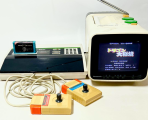 Spread of the Epoch Super Cassette Vision console with Dragon Ball: Dragon Dai-Hikyō


The game's box and instruction manual describe the overall story and premise of the game:
ある山奥に住む無邪気でやたら強い孫悟空は、ブルマの頼みて謎のトラゴンボールを探す旅にてることになった。悟空かゆく、岩山、草原、海原、都市なと7つのコースには、それそれの球が隠されている。次々と襲いかかる敵を、かめはめ波、如意棒てやっつける! 危機また危機!! そして、7つのトラコンホールか揃ったとき。 ついに神龍があらわれる! 一体何か起こるのか!?
Son Goku, an innocent and incredibly strong boy that lives deep in the mountains, departs on a journey to find the mysterious Dragon Balls on a request by a girl named Bulma. All seven of them are hidden throughout the seven stages, so he will have to traverse rocky mountains, grassy fields, the deep ocean, and even the bustling city to find them, as well as beat all the enemies coming one after the other, with his Kamehameha and Nyoibō! It's just danger after danger!! And when all seven Dragon Balls are collected, Shenlong will finally appear! What on Earth will happen then?!
The game's instruction manual adds additional context:
このゲームは主人公悟空が、筋斗雲にのって7つの大秘境を駆けめぐり秘境の奥にある敵要塞から、それぞれのドラゴンボールを探しだすのが目的です。途中、亀仙人がでてきて、修業を受けることができます。修業に合格すると・・・・・・・・・・・・!?
The goal of Goku, this game's protagonist, is to ride his Kinto'un and venture into the uncharted enemy fortresses located inside seven uncharted regions to locate and retrieve the seven Dragon Balls. Meanwhile, he will also find and be trained by the Turtle Hermit. What will happen if the training succeeds...?!
Gameplay
Gameplay takes place in an overhead, vertically-scrolling view with the player having direct control over Goku flying atop Kinto'un, with two possible attack options: swiping Nyoibō (somewhat wildly!) in front (with some minor attack frames to the side-front area), as well as firing a Kamehameha, which takes the form of a small, propelled blast attack.

Players start with five energy points (representing the ability to take five hits from enemies) and three overall lives (representing the number of turns available to play).
At certain points, the game may switch to a one-on-one side-view battle against the Turtle Hermit, in which a separate amount of 20 hit points are available to the player.
-
 Sample overhead gameplay from the first stage
 -
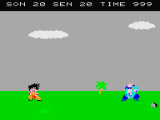 Goku squares off against the Turtle Hermit in a side view


Game Modes
The Great Unexplored Dragon Region is a one- or two-player game with its sole gameplay mode being its main story. In two-player mode, each player takes turns following the complete loss of energy. This repeats until both players lose all remaining lives.
-
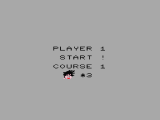 Player 1 start screen
 -
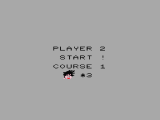 Player 2 start screen


Characters
Playable:
Support:
Large Enemies:
- Big Fish
- Pilaf Machine
- Pilaf
- Bear Bandit
- Toninjinka
- Sergeant Metallic
- Master Sergeant Murasaki
- Oolong's transformation as a bat
- Oolong's transformation as a robot
- Turtle Hermit[b]
Small Enemies/Obstacles:
- Bat
- Baby Gamera
- Shuriken
- Red Ribbon Army Airplane
- Mushroom
- Bird
- Knife
- Axe
- Rocket
Stages
The Great Unexplored Dragon Region features seven unique stages, each with an ending area where you must destroy objects to discover the respective hidden Dragon Ball.
- Stage 1: An introductory stage with flying bat enemies and a jumping fish
- Stage 2: Features more flying enemies, knives, and Pilaf
- Stage 3: Features more flying enemies and Toninjinka
- Stage 4: Features knives, robots, and the bandit bear
- Stage 5: Features additional repeat enemies and Sergeant Metallic
- Stage 6: Features additional repeat enemies
- Stage 7: Features additional repeat enemies and Murasaki
Codes & Secrets
TBD
Releases
TBD
Domestic Media Coverage

Dragon Dai-Hikyō received a small sidebar call-out — within a larger spread that is ostensibly about Dragon Ball: The Mystery of Shenlong, then still in development for the Nintendo Famicom and due out later that year — in the 1986 No. 41 issue of Weekly Shōnen Jump.[2] The blurb simply notes the genre and platform, without much additional fanfare:
なんとエポック社のスーパーカセットビジョンでも出るぜ!!
ドラゴンボールはファミコンだけじゃなく、スーパーカセットビジョンでもゲームができるのだ。筋斗雲に乗って、空中戦タイプのシューティングゲームだ!It's even coming to Epoch's Super Cassette Vision!!
Dragon Ball isn't just for the Famicom; you can play it on the Super Cassette Vision, too! It's an aerial combat shooting game where you ride on Kinto'un!
Legacy
BEEP Magazine Charts

Dragon Dai-Hikyō was notable for regularly topping the Super Cassette Vision's respective "TELEHOBBY GAME TOP CHART" in the Japanese gaming magazine BEEP beginning shortly after its release — it supplanted Dragon Slayer in the top spot starting in the December 1986 issue[3][c], and largely stayed there (or close to it) until the removal of the Super Cassette Vision's listing entirely as of the September 1987 issue.[4][5][d]
- December 1986 Issue: #1 (Debut)[3][6]
- January 1987 Issue: #1[7][8]
- February 1987 Issue: #1[9][10]
- March 1987 Issue: #1[11][12]
- April 1987 Issue: #2[13][14]
- May 1987 Issue: #1[15][16]
- June 1987 Issue: #1[17][18]
- July 1987 Issue: #1[19][20]
- August 1987 Issue: #2[4][5]
Official Citations
Dragon Dai-Hikyō is not typically included in official lists of Dragon Ball video games by Shueisha; for example, it is completely missing from 2016's 30th Anniversary: Dragon Ball Chōshishū –Super History Book–, with no sales data or even the most cursory listing or footnote regarding the game.
Unofficial Port
In 2022, the user Diskover on the NesDev forums[21] (and @RetroNES_Soft on Twitter[22]) posted a short, in-progress "alpha 1.1" port of the game to the Nintendo Famicom using the UNROM mapper, music from Dragon Ball: The Mystery of Shenlong, and a mixture of sprite assets both unique in creation as well as some from the original Super Cassette Vision game.
Game Credits
No credits are provided within the game itself (or within the game's manual), other than the main screen copyright info of (with the latter-most likely referring to "Bird Studio" followed by "Shueisha" and "Fuji Television"):
- ©1986 EPOCH CO LT
- ©BS/S.F.T
External Links
- Random Game Log (チラ裏げーむ録)
- https://iza-namakura.hateblo.jp/entry/1986/03/25/111111
- https://iza-namakura.hateblo.jp/entry/1986/03/25/222222
- https://iza-namakura.hateblo.jp/entry/1986/03/25/333333
- https://iza-namakura.hateblo.jp/entry/1986/03/25/444444
- https://iza-namakura.hateblo.jp/entry/1986/03/25/555555
- https://iza-namakura.hateblo.jp/entry/1986/03/25/666666
- https://iza-namakura.hateblo.jp/entry/1986/03/25/777777
- https://iza-namakura.hateblo.jp/entry/1986/03/25/888888
- https://iza-namakura.hateblo.jp/entry/1986/03/25/999999
- https://iza-namakura.hateblo.jp/entry/1986/03/25/000000
- https://iza-namakura.hateblo.jp/entry/2023/03/25/200000
- Hardcore Gaming 101
- Super Cassette Vision Information
Notes
- ↑ Only seen in the game's ending sequence as panties fall down on Oolong.
- ↑ As an active opponent, the Turtle Hermit only appears for training side-missions, which do not otherwise impede the player's progress to take energy away from their main gameplay.
- ↑ For lack of a better source right now, we are going with the release date of this December 1986 issue as 08 November 1986 based on this wiki article page on Sega Retro.
- ↑ Dragon Dai-Hikyō dropped to the #2 spot (under Pole Position II) in the August 1987 issue, and Super Cassette Vision is gone as of the September 1987 issue.
References
- ↑ [citation needed]
- ↑ 2.0 2.1 ファミコン最新ゲームあたた大紹介. Weekly Shōnen Jump, 1986 #41. Japan: Shueisha, 22 September 1986. (p. 7)
- ↑ 3.0 3.1 3.2 テレホビーゲームTOPチャート. BEEP, December 1986. Japan: SoftBank, 08 November 1986. (p. 169)
- ↑ 4.0 4.1 テレホビーゲームTOPチャート. BEEP, August 1987. Japan: SoftBank, TBD August 1987. (p. 168)
- ↑ 5.0 5.1 @sekiro_51 (12 December 2025). Twitter. Retrieved: 24 June 2026.
- ↑ @sekiro_51 (21 December 2025). Twitter. Retrieved: 24 June 2026.
- ↑ テレホビーゲームTOPチャート. BEEP, January 1987. Japan: SoftBank, TBD. (p. 164)
- ↑ @sekiro_51 (20 December 2025). Twitter. Retrieved: 24 June 2026.
- ↑ テレホビーゲームTOPチャート. BEEP, February 1987. Japan: SoftBank, TBD. (p. 161)
- ↑ @sekiro_51 (19 December 2025). Twitter. Retrieved: 24 June 2026.
- ↑ テレホビーゲームTOPチャート. BEEP, March 1987. Japan: SoftBank, TBD. (p. 166)
- ↑ @sekiro_51 (18 December 2025). Twitter. Retrieved: 24 June 2026.
- ↑ テレホビーゲームTOPチャート. BEEP, April 1987. Japan: SoftBank, TBD. (p. 173)
- ↑ @sekiro_51 (16 December 2025). Twitter. Retrieved: 24 June 2026.
- ↑ テレホビーゲームTOPチャート. BEEP, May 1987. Japan: SoftBank, TBD. (p. 164)
- ↑ @sekiro_51 (16 December 2025). Twitter. Retrieved: 24 June 2026.
- ↑ テレホビーゲームTOPチャート. BEEP, June 1987. Japan: SoftBank, TBD. (p. 162)
- ↑ @sekiro_51 (15 December 2025). Twitter. Retrieved: 24 June 2026.
- ↑ テレホビーゲームTOPチャート. BEEP, June 1987. Japan: SoftBank, TBD. (p. 172)
- ↑ @sekiro_51 (13 December 2025). Twitter. Retrieved: 24 June 2026.
- ↑ "Dragon Ball: Dragon Daihikyou (port for NES)" (01 February 2022). NesDev. Retrieved: 12 June 2026.
- ↑ @sekiro_51 (01 February 2022). Twitter. Retrieved: 12 June 2026.
| ||||||||||||||||||||||||||||||||||||||||||||||||||||||||||||||||||||