
Sun Wukong

|
This page is incomplete. Kanzenshuu wiki team members are aware that they must edit this page to add missing information and complete it. |

|
A note about this article's content: This article is about a topic that is tangentially related to Akira Toriyama and/or Dragon Ball. As such, it may appear to give otherwise undue importance or priority in its writing toward one or more of those subjects. For a more comprehensive view on this subject matter, we encourage you to explore the article's links to other authoritative, holistic sources. |
| Sun Wukong | |
|---|---|
| 孫悟空 (Son Gokū) | |
| Personal Data | |
| Aliases | Great Sage, Equal to Heaven |
The monkey king Sun Wukong is one of the main characters from the 16th century Chinese novel Journey to the West by Wu Cheng'en, and serves as the underlying basis for the character that ultimately became Son Goku, the main protagonist of Akira Toriyama's Dragon Ball franchise.
Though he shares a history of development tracking back to Journey to the West, Son Goku from Dragon Ball is a distinct character from Sun Wukong.
Biography
TBD
Name
Initially known as the "stone monkey" (石猴 Shí Hóu) and later as the "handsome monkey king" (美猴王 Měi Hóuwáng), "Sun Wukong" (孫悟空 Sūn Wùkōng) is one of the monkey king's various titles, given to him by his first master, the Taoist monk Subodhi:[1]
The Patriarch laughed and said, "Though your features are not the most attractive, you do resemble a monkey (hu-sun) that feeds on pine seeds. This gives me the idea of deriving your surname from your appearance. I intended to call you by the name 'Hu.' Now, when the accompanying animal radical is dropped from this word, what's left is a compound made up of the two characters, ku and yüeh. Ku means aged and yüeh means female, but an aged female cannot reproduce. Therefore, it is better to give you the surname of 'Sun'. When the accompanying radical is dropped from this word, we have the compound of tzŭ and hsi. Tzŭ means a boy and hsi means a baby, so that the name exactly accords with the Doctrine of the Baby. So your surname will be 'Sun'." When the Monkey King heard this, he was filled with delight. "Splendid! Splendid!" he cried, kowtowing. "At least I know my surname. May the Master be even more gracious! Since I have receive the surname, let me be given also a personal name, so that it may facilitate your calling and commanding me." The Patriarch said, "Within my tradition are twelve characters which have been used to name the pupils according to their divisions. You are one who belongs to the tenth generation." "Which twelve characters are they?" asked the Monkey King. The Patriarch said, "They are: wide (kuang), great (ta), wise (chih), intelligence (hui), true (chên), conforming (ju), nature (hsing), sea (hai), sharp (ying), wake-to (wu), complete (yüan), and awakening (chüeh). Your rank falls precisely on the word 'wake-to' (wu). You will hence be given the religious name 'Wake-to-Vacuity' (wu-k'ung). All right?" "Splendid! Splendid!" said the Monkey King, laughing: "henceforth I shall be called Sun Wu-k'ung."
— The Journey to the West Volume 1, Translated and Edited by Anthony C. Yu
Subsequent adventures and shenanigans result in the empty and degrading title/position of "Keeper of the Heavenly Horses" (弼馬溫 Bìmǎwēn, a sly homophone of 避馬瘟 bìmǎwēn or "to prevent horse's disease", intended to insult Wukong without him knowing it), followed by Wukong's own self-proclaimed title of "Great Sage, Equal to Heaven" (齊天大聖 Qítiān Dàshèng).
The same Chinese characters of 孫悟空 pronounced as Sūn Wùkōng in Chinese are pronounced as Son Gokū in Japanese. Because the name is taken directly from its source material, various other "Son Goku" (or simply "Goku") characters exist throughout other — even sometimes contemporary — manga and anime series that likewise take inspiration from or otherwise adapt Journey to the West. Some of these include, but are not limited to:
- Jan Kūgo (anagram of "Gokū") from Yugo Serikawa and Leiji Matsumoto's SF Saiyūki Starzinger
- Gokū Furinji, from Buichi Terasawa's Midnight Eye Goku
- Son Gokū, from Kazuya Minekura's Saiyuki
- Gokū, from Jōji Arimori and Romu Aoi's Asobotto Senki Gokū
-
 Jan Kūgo from SF Saiyūki Starzinger
 -
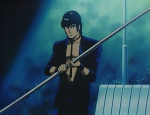 Gokū Furinji from Midnight Eye Goku
 -
 Son Gokū from Saiyuki
 -
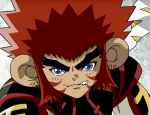 Gokū from Asobotto Senki Gokū


Similarly, many video game characters follow the same pattern based on the same source material, including (but not limited to):
- The unnamed main character built out of breakable blocks, from the 1979 arcade game Monkey Magic by Nintendo
- SonSon, from the 1984 video game SonSon by Capcom
- Sun Wukong, from the 1986 video game Ganso Saiyūki: Super Monkey Daibōken by Techno Quest
- Sun Wukong (or "Wu Kong" or "Mike Chen"), from the 1988 video game Chūka Taisen
- Goku, from the 1989 video game Famicom Mukashibanashi: Yūyūki by Nintendo
- SonSon (Son Goku), from the 1989 video game SonSon II by Capcom
- Wukong, from the 1996 video game Legend of Wukong by Ming Technology Co., Ltd
- Son Goku, from the 1999 video game Saiyuki: Journey West by Koei
- Kongo, from the 1999 video game Monkey Magic by Sunsoft
- Monkey, from the 1999 video game Monkey Hero by Take-Two Interactive
- SonSon III (granddaughter of the original SonSon), from the 2000 video game Marvel vs. Capcom 2: New Age of Heroes by Capcom
- Son Goku, from the 2007 video game Saiyūki: Kinkaku Ginkaku no Inbō by D3PUBLISHER
- Monkey, from the 2010 video game Enslaved: Odyssey to the West by Ninja Theory
- Wukong, a 2011 addition to the 2009 video game League of Legends by Riot Games
- Sun Wukong, from the 2019 video game Sun Wukong VS Robot by Bitca
- Sun Wokong, from the 2019 video game Monkey King: Hero is Back by THQ Nordic
- Qitian Dasheng, a 2019 dungeon boss addition to the 2010 video game Final Fantasy XIV by Square Enix
- Wukong, from the 2019 video game Wukong by Gammera Nest SL
- Wukong, from the 2019 video game Unruly Heroes by Magic Design Studios
- The Destined One (and Sun Wukong himself), from the 2024 video game Black Myth: Wukong by Game Science
-
 SonSon in the 1984 video game SonSon
 -
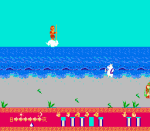 Wukong in the 1986 video game Ganso Saiyūki: Super Monkey Daibōken
 -
 Wukong in the 1988 video game Chūka Taisen
 -
 Wukong in the 2001 video game Saiyuki: Journey West
 -
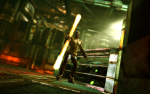 Monkey in the 2010 video game Enslaved: Odyssey to the West
 -
 Wukong in the 2019 video game Sun Wukong VS Robot
 -
 Qitian Dasheng, a 2019 dungeon boss addition to the 2010 video game Final Fantasy XIV
 -
 The Destined One from the 2024 video game Black Myth: Wukong


Notable Techniques
While Sun Wukong showcases an enormous number of techniques throughout the full story of Journey to the West (for example, his 72 transformations), the following are of most relevance to Dragon Ball and in turn Son Goku:
The Compliant Golden-Hooped Rod
In Journey to the West, Wukong — not content with a mere scimitar he had stolen from the Monstrous King of Havoc — seeks a weapon to match his skill from Ao Guang (敖廣), the Dragon King of the East Sea. When he arrives, he finds that none of the Dragon King's weapons are strong enough to match his strength. After dismissing all of the significant weapons in the treasury (including a long-handed scimitar, a nine-pronged fork, and a giant halberd), all that remains is a giant, barrel-sized iron rod. The rod had been glowing for the last several days, which the dragon family takes as some sort of sign relevant to the Monkey King. Sun Wukong lifts the pillar and, content with its weight (whereas all of the previous weapons felt too light), finds that he is able to command it to both grow and reduce in size at will. The rod is inscribed with its name and weight: 如意金箍棒重一萬三千五百斤 ("The Compliant Golden-Hooped Rod. Weight: 13,500 Catties"[2]). Intimidated by his overwhelming power and talent, the Dragon King lets Sun Wukong take the rod with him, along with fantastic clothing coerced from his fellow dragon brethren.[3]
That piece of iron—a small stroke with it is deadly and a light tap is fatal! The slightest touch will crack the skin and a small rap will injure the muscles!
— The Journey to the West Volume 1, Translated and Edited by Anthony C. Yu (page 107)
As with other techniques and weaponry, Sun Wukong is able to immediately master his usage of the Compliant Golden-Hooped Rod, which remains in use throughout the rest of the tale.[4] Sun Wukong typically shrinks it down to the size of a needle to hide by his ear, calling it forth — and even duplicating it[5] — at will.
He held the treasure in his hands and called out, "Smaller, smaller, smaller!" and at once it shrank to the size of a tiny embroidery needle, small enough to be hidden inside the ear. Awe-struck, the monkeys cried, "Great King! Take it out and play with it some more." The Monkey King took it out from his ear and placed it on his palm. "Bigger, bigger, bigger!" he shouted, and again it grew to the thickness of a barrel and more than twenty feet long. He became so delighted playing with it that he jumped onto the bridge and walked out of the cave. Grasping the treasure in his hands, he began to perform the magic of cosmic imitation. He bent over and cried, "Grow!" and at once grew to be ten thousand feet tall, with a head like the T'ai Mountain and a chest like a rugged peak, eyes like lightning and a mouth like a blood bowl, and teeth like swords and halberds. The cudgel in his hands was of such a size that its top reached the thirty-third Heaven and its bottom the eighteenth layer of Hell. Tigers, leopards, wolves, and crawling creatures, all the monsters of the mountain and the demon kinds of the seventy-two caves, were so terrified that they kowtowed and paid homage to the Monkey King in fear and trembling. Presently he revoked his magical appearance and changed the treasure back into a tiny embroidery needle stored in his ear. He returned to the cave dwelling, but the demon kings of the various caves were still frightened, and they continued to come to pay their respects.
— The Journey to the West Volume 1, Translated and Edited by Anthony C. Yu (page 107)
Cloud Somersault
In search of knowledge to become an immortal, Sun Wukong leaves his homeland of the Flower-Fruit Mountain in the country of Ao-lai on the East Pūrvavideha Continent, eventually making his way across the Great Western Ocean to the West Aparagodānīya Continent. It is here that he meets and trains under his first master, Subodhi (based on the real-life figure in Buddhism). After several years of training and amassing great knowledge, in order to avoid the three calamities that will eventually take his life, Wukong learns the Art of the Earthly Multitude, which numbers seventy-two transformations. After some time, asks Wukong to show what he has learned. He leaps 50 or 60 feet in the air, pulling himself up with a somersault, and for the time of a meal, travels no more than three miles. Wukong calls this "cloud-soaring", but Subodhi is not impressed, and instead refers to it as "cloud-crawling" instead, if even worthy of being called that:
The Patriarch said, "Those who are capable of cloud-soaring may start from the North Sea in the morning, journey through the East Sea, the West Sea, the South Sea, and return again to Ts'ang-wu. Ts'ang-wu refers to Ling-ling in the North Sea. It can be called true cloud-soaring only when you can traverse all four seas in one day." "That's truly difficult!" said Wu-k'ung, "truly difficult!" "Nothing in the world is difficult," said the Patriarch; "only the mind makes it so." When Wu-k'ung heard these words, he kowtowed reverently and implored the Patriarch. "Master, if you do perform a service for someone, you must do it thoroughly. May you be most merciful and impart to me also this technique of cloud-soaring. I would never dare forget your gracious favor." The Patriarch said, "When the various immortals want to soar on the clouds, they all rise by stamping their feet. But you're not like them. When I saw you leave just now, you had to pull yourself up by jumping. What I'll do now is teach you the cloud-somersault in accordance with your form." Wu-k'ung again prostrated himself and pleaded with him, and the Patriarch gave him an oral formula, saying, "Make the magic sign, recite the spell, clench your fist tightly, shake your body, and when you jump up, one somersault will carry you a hundred and eight thousand miles."
— The Journey to the West Volume 1, Translated and Edited by Anthony C. Yu (page 91)
Wukong practices the technique throughout the night and masters it immediately.
While the technique is frequently referred to throughout the tale as traveling via a single cloud, the inherent name of a "somersault cloud" technique brings to mind that of Wukong actually leaping from cloud to cloud across the sky, and both types of depictions can in fact be seen throughout the story:
Wu-k'ung lowered the direction of his cloud and landed squarely on the Flower-Fruit Mountain.
— The Journey to the West Volume 1, Translated and Edited by Anthony C. Yu (page 94)
The Great Sage immediately left the cave and, with one somersault, went directly back to the Festival of Immortal Peaches, again using the magic of body concealment.
— The Journey to the West Volume 1, Translated and Edited by Anthony C. Yu (page 142)
TBD, example of multiple somersaults
— The Journey to the West Volume 4, Translated and Edited by Anthony C. Yu (page ##)
Wukong's somersault cloud technique is also capable of transporting multiple passengers, though their spiritual purity determines their ability to be carried:
Dear Monkey King. He recited a spell, rode for a while on a fierce wind, and then lowered the direction of the cloud. "Little ones," he cried, "open your eyes!" The monkeys felt solid ground beneath their feet and recognized their home territory.
— The Journey to the West Volume 1, Translated and Edited by Anthony C. Yu (page 98)
Pilgrim swiftly mounted the clouds and went north to beg a bowl of vegetarian food from some family to present to his master. When the master saw him return so soon, he said, "Wu-k'ung, let us go to that household which gave us the food and ask them how we may cross this river. Isn't this better than fighting the monster?" With a laugh, Pilgrim said, "That household is quite far from here, about six or seven thousand miles, no less! How could the people there know about the water? What's the use of asking them" "You are fibbing again, Elder Brother!" said Pa-chieh. "Six or seven thousand miles how could you cover that distance so quickly? "You have no idea," said Pilgrim, "about the capacity of my cloud-somersault, which with one leap can cover a hundred and eight thousand miles. For the six or seven thousand here, all I have to do is to nod my head and stretch my waist, and that's a round trip already! What's so heard about that?" "Elder Brother," said Pa-chieh, "if it's so easy, all you need to do is to carry Master on your back: nod your head, stretch your waist, and jump across. Why continue to fight this monster?" "Don't you know how to ride the clouds?" asked Pilgrim. "Can't you carry him across the river?" "The mortal nature and worldly bones of Master are as heavy as the T'ai Mountain," Pa-chieh said. "How could my cloud-soaring bear him up? It has to be your cloud-somersault." "My cloud-somersault is essentially like cloud-soaring," said Pilgrim, "the only difference being that I can cover greater distances more rapidly. If you can't carry him, what makes you think I can? There's an old proverb which says: 'Move the T'ai Mountain, and it's as light as the mustard seed, but carry a mortal and you won't leave the red dust behind!' Take this monster here: he can't carry a human into the air. And if it's this kind of magic, old Monkey knows every trick well, including becoming invisible and making distances shorter. But it is required of Master to go through all these strange territories before he finds deliverance from the sea of sorrows; hence even one step turns out to be difficult. You and I are only his protective companions, guarding his body and life, but we cannot exempt him from these woes, nor can we obtain the scriptures all by ourselves. Even if we had the ability to go and see Buddha first, he would not bestow the scriptures on you and me. Remember the adage: 'What's easily gotten, is soon forgotten.'" When Idiot heard these words, he accepted them amiably as instruction. Master and disciples ate some of the simply prepared vegetarian food before resting on the eastern shore of the Flowing-Sand River.
— The Journey to the West Volume 1, Translated and Edited by Anthony C. Yu (pages 435-436)
Dragon Ball Production


Origin in Journey to the West
Like several elements within early Dragon Ball[7][8], Son Goku finds his inspiration in Journey to the West, a classical Chinese folk novel published in the 16th century by Wu Cheng'en.
Pre-Dragon Ball
Between the Dragon Boy and The Adventure of Tongpoo prototype publications in 1983 and Dragon Ball's first publication in November 1984, Akira Toriyama developed drafts of the Dragon Ball stories with his editor Kazuhiko Torishima. The early drafts elaborated on the original Dragon Boy concept, incorporating elements from Journey to the West.[7][9] Having decided on a young female companion (no doubt shaped by both Dragon Boy and specifically The Adventure of Tongpoo), a western-style girl took the role of Tripitaka. Toriyama's design of Son Goku was literally that of the Monkey King himself, complete with the head decoration and staff. Zhu Bajie came over mostly intact as well, complete with his trademark rake.[6] In these early stages, it was indeed still a somewhat-faithful adaptation of Journey to the West, and was in fact rejected for being so faithful.[10]
In Toriyama's third pass — which moved through both pilot and final manuscripts — story details began to take form, as well as the names for other supporting characters. At this point, only Son Goku retains his original name from Journey to the West.[6]
Dragon Ball
Son Goku was retained into the final version of the manga. While Dragon Ball's Son Goku is similar to the original Sun Wukong in some ways (most notably Kinto'un, Nyoi-Bō, and the Great Ape transformation likely being an allusion to Wukong's ability to transform), by and large the characters are completely unrelated.
Sun Wukong Artwork by Akira Toriyama


A side-by-side drawing of "the original Son Goku" (元祖孫悟空 Ganzo Son Gokū)[11] and Son Goku from Dragon Ball was included on an interstitial page in the sixth collected volume of the Dragon Ball manga in 1986.[12] This drawing was featured as the Dragon Ball Official Site's 153rd entry in its The Nearly Complete Works of Akira Toriyama ongoing weekday column in August 2018.[11]
Akira Toriyama provided a full-color drawing of Son Goku, Son Gohan, Kuririn, and Piccolo — depicted as stand-ins for Sun Wukong, Zhu Bajie, Tripitaka, and Sha Wujing, respectively, with appropriate clothing and accessories — for the "Catchphrase Grand Prix" feature in the 1989 No. 23 issue of Shueisha's Weekly Shōnen Jump in Japan. The illustration received full-page reprints in Akira Toriyama - The World[13] and Dragon Ball Daizenshuu 1 ("The Complete Illustrations"),[14] a quarter-page reprint in the Dragon Ball Chōgashū ("A Visual History"),[15] and a small reprint for the "Dragon Ball Secret File" feature in the 30th Anniversary Super History Book.[16] Viz repurposed this same image as the cover artwork for their fourth monthly issue of the "Dragon Ball Z"-branded comic release in June 1998.
In 2014, Stephen Chow's own fandom of Dragon Ball led to Akira Toriyama drawing Sun Wukong for poster artwork for Chow's film Journey to the West: Conquering the Demons, which Toriyama also provided a glowing comment for.[17] This drawing was featured as the 153rd entry in The Nearly Complete Works of Akira Toriyama in May 2018.[18]
The mightiest fun in the galaxy, far surpassing the walls of expectations and common sense!!
This is the first perfect popcorn-movie I've seen in a long time!
Intense energy that makes you not care about the trivial details! Masterful allocation of seriousness and comedy! Shamelessly cheap-looking staging! Calculated story developments! This is the pinnacle of my ideal in popcorn-movies! I have nothing to gain through this flattery, so it's 100% no exaggeration, no nothing.
Due to the nature of my profession, I have a bad habit where when I watch a movie, I always end up thinking about subsequent plot developments, but in spite of this movie having the motif of the famous Journey to the West, I couldn't predict where it was going at all. Not even stupid established concepts like film theory or rules hold true. As a result of this wonderful betrayal, it is a properly magnificent, new Journey to the West that only its birthplace could deliver, and I'm positively moved at how it's punctuated by the director's usual themes of "love" and "little gags."
It really comes across on the screen that the director was able to complete the movie exactly according to his passion and vision. When we're inundated with big blockbuster movies that are all long on visuals but short on ambition or individuality, pandering to audiences for the sake of box-office earnings, how thrilled I would have been at its delightfulness for this fact alone! It was just the greatest Journey to the West, so much so that I don't even know how to express it!!
Incidentally, the characters' individual traits and the casting of the actors were also wonderful, and I was especially impressed at the acting skill of the person who played Sun Wukong, who at first could seem like an unexpected choice, appearance-wise.
— Akira Toriyama
In 2017, Toriyama provided another side-by-side drawing (along with a celebratory comment) of Sun Wukong and Son Goku for the television special program Showa vs. Heisei: Anime, Tokusatsu, Manga Hero & Heroine Top 20, where Dragon Ball's own Son Goku was ultimately named the number one hero:[19][20][21]
Even though I knew that battle manga went over well with readers of shōnen manga, I still stubbornly decided to do a Journey to the West adventure manga. Since it'd be a bit drab to just leave things as-is, I changed the monkey to a human with a tail and started off a modified version of Journey to the West where they search for the seven Dragon Balls.
But sure enough it didn't get very popular, so I had no choice but to obediently change course to a battle-centric manga. Afterwards I got rid of the tail (it was in the way) and so in the end only the name "Son Goku" remained.
Thank you very much for selecting that Goku as the number one strongest hero!!
— Akira Toriyama
Additional Sun Wukong References in Dragon Ball Media and Products
Son Gohan is depicted in Sun Wukong's attire and holding Nyoi-Bō in the title page to chapter 207 of the Dragon Ball manga in January 1989; this was three months prior to this shot being mirrored as the closing shot to "Come Out, Incredible ZENKAI Power!," the first closing theme to the Dragon Ball Z television series.


Akira Toriyama provided an illustrated entry for the "Catchphrase Grand Prix" (キャッチフレーズグランプリ) in the 1989 #23 issue of Weekly Shōnen Jump, featuring Goku, Piccolo, Gohan, and Kuririn dressed up as Wukong, Sandy, Pigsy, and Tripitaka, respectively. This same illustration was included as a pullout poster for the Weekly Shōnen Jump "Summer Special" issue for 1989.
The "SON GOKU 〈ONWARDS TO ADVENTURE〉" figure[22] releasing 23 October 2026 is directly modeled off of this illustration.
-
 Top portion of the back side of the pullout "Catcphrase Grand Prix" poster spotlight from the 1989 No. 23 issue of Weekly Shōnen Jump
 -
 Pullout poster from the Weekly Shonen Jump 1989 "Summer Special" issue
 -
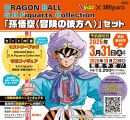 Promotional image for the "SON GOKU 〈ONWARDS TO ADVENTURE〉" S.H.Figuarts release


TO DO: Goku figure in Wukong outfit based on 1989 drawing; sculpted by Manabu Yamashita for the Bandai World Figure Colosseum line
-
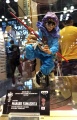 Photograph from New York Comic Con 2018 showcasing Manabu Yamashita's Bandai World Figure Colosseum contribution

References
- ↑ Wu Cheng'en. Yu, Anthony C. The Journey to the West Volume 1. USA: The University of Chicago Press, 1977. ISBN 0-226-97150-3. (Chapter 1, p. 82)
- ↑ "Deciphering the Inscription on the Monkey King’s Staff" (29 December 2014). Journey to the West Research. Retrieved: 02 October 2020.
- ↑ Wu Cheng'en. Yu, Anthony C. The Journey to the West Volume 1. USA: The University of Chicago Press, 1977. ISBN 0-226-97150-3. (chp #, p. #)
- ↑ Wu Cheng'en. Yu, Anthony C. The Journey to the West Volume 1. USA: The University of Chicago Press, 1977. ISBN 0-226-97150-3. (chp #, p. #)
- ↑ JTTW CHP TBD
- ↑ 6.0 6.1 6.2 6.3 "BEFORE DRAGON BALL". Dragon Ball Daizenshuu 2: Story Guide. Japan: Shueisha, 04 August 1995. ISBN 4-08-782752-6. (p. 90)
- ↑ 7.0 7.1 Toriyama, Akira. "The Making of Dragon Ball". Bird Land Press 15. November 1984.
Kanzenshuu Translations Archive: Bird Land Press 15 - "The Making of Dragon Ball" - ↑ "Akira Toriyama Super Interview". Dragon Ball Daizenshuu 2: Story Guide. Japan: Shueisha, 04 August 1995. ISBN 4-08-782752-6. (pp. 261-265)
Kanzenshuu Translations Archive: Dragon Ball Daizenshuu 2: Story Guide - "Akira Toriyama Super Interview" - ↑ "Kazuhiko Torishima On Shaping The Success Of 'Dragon Ball' And The Origins Of 'Dragon Quest'" (15 October 2016). Forbes. Retrieved: 02 October 2020.
- ↑ "TBD". Dragon Ball: Adventure Special. Japan: Shueisha, 18 November 1987. (p. TBD)
- ↑ 11.0 11.1 "【鳥山明ほぼ全仕事】 平日更新24時間限定公開! 2018/08/23" (23 August 2018). Dragon Ball Official Site. Retrieved: 23 October 2018.
- ↑ Toriyama, Akira. Dragon Ball Volume 3: The Tenka'ichi Budōkai Begins!!. Japan: Shueisha, 10 June 1986. ISBN 4-08-851833-0. (p. TBD)
- ↑ "Dragon Ball". Akira Toriyama - The World. Japan: Shueisha, 15 January 1990. ISBN 4-08-858130-X). (p. 34)
- ↑ "1989". Dragon Ball Daizenshuu 1: Complete Illustrations. Japan: Shueisha, 25 June 1995. ISBN 4-08-782751-8. (p. 73)
- ↑ "1989". Dragon Ball Chōgashū. Japan: Shueisha, 09 May 2013. ISBN 978-4-08-782520-6. (p. 55)
- ↑ "The PERIOD of DRAGON BALL: EPISODE 1989-1992". 30th Anniversary: Dragon Ball Chōshishū –Super History Book–. Japan: Shueisha, 21 January 2016. ISBN 978-4-08-792505-0. (p. 52)
- ↑ "Akira Toriyama Draws Sun Wukong in Support of Chow Film" (07 November 2014). Kanzenshuu. Retrieved: 30 August 2021.
- ↑ "【鳥山明ほぼ全仕事】 平日更新24時間限定公開! 2018/05/31" (31 May 2018). Dragon Ball Official Site. Retrieved: 31 May 2018.
- ↑ "昭和VS平成!?マンガ、アニメ、特撮のヒーロー&ヒロイントップ20発表" (21 August 2017). Natalie. Retrieved: 30 August 2021.
- ↑ "New Translations: “Showa vs. Heisei!?” Special, “Resurrection ‘F'” Anime Comic, and “Dr. Slump” Volume 18 Akira Toriyama Comments" (14 September 2017). Kanzenshuu. Retrieved: 30 August 2021.
- ↑ "Kanzenshuu Translations Archive: Showa vs. Heisei: Anime, Tokusatsu, Manga Hero & Heroine Top 20" (14 September 2017). Kanzenshuu. Retrieved: 30 August 2021.
- ↑ "【予約開始】ヒストリーブック&可動フィギュアの豪華セット『DRAGON BALL S.H.Figuarts Collection 「孫悟空〈冒険の彼方へ〉」セット』!!" (26 January 2026). Dragon Ball Official Site. Retrieved: 05 February 2026.